Business Development in a Changing World: Why Relationships Still Win
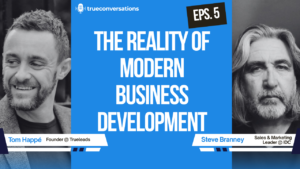
In a recent episode of the True Conversations podcast, Tom sat down with Steve, a seasoned technology sales professional with over 35 years of experience, to explore how business development has evolved, and what still matters most.
With a career spanning global enterprises like AT&T and Trustwave, alongside time spent in startups, Steve brings a unique perspective shaped by decades of change across the technology and sales landscape.
What quickly becomes clear is that while tools, platforms, and expectations have shifted dramatically, the core principles of effective business development remain surprisingly consistent.
What Business Development Really Means
At its core, business development is not about closing deals.
As Steve explains, the objective is much earlier in the process. It is about building relationships and positioning yourself in a way that creates the opportunity to sell.
This distinction is important. Too often, sales professionals rush into pitching solutions before they have earned the right to have that conversation.
Instead, modern business development requires a deeper level of understanding. It means knowing what a potential customer is trying to achieve, what challenges they are facing, and how your organisation can genuinely support those objectives.
From Volume to Relevance
The conversation highlights a significant shift in how outreach works today.
In the past, success often came from volume. Cold calls, mass emails, and broad prospecting efforts were standard practice. Today, that approach is far less effective.
With the sheer volume of digital noise, people are far more selective about what they engage with. Generic outreach is easily ignored.
Steve emphasises the importance of doing the groundwork. Platforms like LinkedIn provide access to valuable insights, from professional backgrounds to the content individuals engage with and share. This allows sales professionals to tailor their approach and ensure their messaging is relevant.
A targeted message sent to 20 well-researched prospects is far more likely to generate meaningful conversations than a generic message sent to 100.
The Role of AI and Data
With the rise of AI and automation, sales teams now have access to more information than ever before.
Research that once took hours can now be completed in minutes. Alerts, insights, and data points are readily available.
However, Steve is clear that these tools should support, not replace, human judgement.
AI can help structure outreach or summarise information, but it cannot replicate genuine understanding or authentic communication. In fact, poorly used automation can have the opposite effect, making interactions feel impersonal and disconnected.
The key is balance. Use technology to become more informed and efficient, but ensure that every interaction still feels human.
Building Relationships Beyond the Surface
One of the most valuable insights from the discussion is the importance of building broad relationships within an organisation.
Many sales professionals rely heavily on a single contact. While that relationship may feel strong, it can also be fragile. If that individual moves roles or lacks decision-making authority, opportunities can quickly stall.
Steve advises expanding relationships across multiple departments and seniority levels. This not only reduces risk but also provides a clearer understanding of the organisation as a whole.
It also helps uncover different perspectives, priorities, and internal dynamics that may influence decision-making.
Balancing Short-Term Pressure with Long-Term Value
A recurring challenge in modern sales environments is the pressure of short-term targets.
Quarterly reporting cycles and monthly goals can push sales teams to focus on immediate wins, sometimes at the expense of long-term relationships.
Steve acknowledges this tension. While targets are unavoidable, he stresses the importance of managing expectations through clear communication and planning.
By mapping out the buying process early, understanding procurement timelines, and aligning with the customer’s own objectives, sales professionals can reduce pressure on both sides.
This approach builds trust and ensures that deals progress at a pace that works for everyone involved.
The Human Element Still Matters
Despite advances in technology, one theme stands out above all else.
Business development is still fundamentally about people.
Understanding that there is a human being behind every email or LinkedIn profile is crucial. Personal motivations, career goals, and individual challenges all play a role in decision-making.
Steve shares examples of relationships that have gone beyond business, with customers seeking career advice or maintaining connections over many years. These are the kinds of relationships that create lasting value.
The Return of Face-to-Face Interaction
Interestingly, the conversation also points to a growing desire for in-person engagement.
While remote communication has become the norm, there is a renewed appreciation for face-to-face meetings. These interactions often accelerate trust and decision-making in ways that virtual meetings cannot.
A single in-person session can achieve what might otherwise take weeks of scheduled calls.
For sales professionals, this presents an opportunity to stand out by combining digital efficiency with genuine, personal interaction.
Learning Through Experience
There is no single formula for success in business development.
As Steve points out, different people approach it in different ways, and much of the learning comes through experience. Failure is part of the process, and each misstep provides valuable insight into what works and what does not.
However, one area that is often overlooked is training. While many organisations focus heavily on product knowledge, fewer invest in developing the softer skills required for effective relationship building, communication, and strategic thinking.
These skills are what ultimately differentiate high performers.
Starting from Zero
When asked how he would approach a new role with no existing pipeline, Steve’s answer is straightforward.
Start with understanding.
Use available tools to learn about the market, identify key players, and build a clear picture of potential opportunities. Combine this with networking, events, and leveraging existing connections wherever possible.
At the same time, remain proactive. Outreach, both warm and cold, still has a place when done thoughtfully.
Above all, consistency is key. Building a pipeline takes time, effort, and resilience.
Final Thoughts
Business development has undoubtedly changed.
The tools are more advanced, the pace is faster, and expectations are higher. Yet the fundamentals remain the same.
Success comes from understanding people, building trust, and creating meaningful connections.
In a world filled with automation and noise, those who focus on relevance, authenticity, and genuine relationships will continue to stand out.