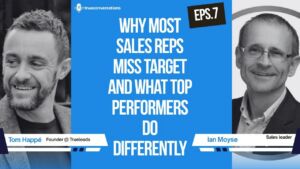
Hitting sales targets has never been more difficult. Despite the rise of AI tools, automation platforms, LinkedIn outreach systems, and endless streams of sales technology, many sales teams are still underperforming.
In a recent episode of the True Conversations podcast, sales leader Ian Moy shared decades of experience leading startup and scaleup sales teams, revealing why most reps struggle to hit target and what the best performers consistently do differently.
The reality is simple. Technology has changed sales, but the fundamentals still win.
Sales Has Become Harder, Not Easier
One of the biggest misconceptions in modern sales is that more technology automatically means better results.
Today’s sales reps have access to more tools than ever before. AI research tools, automated outreach platforms, LinkedIn automation, call analytics, and intent data should theoretically make pipeline generation easier.
Instead, many sales teams are overwhelmed.
Modern buyers are more informed, more distracted, and more protective of their time than ever before. Prospects now research vendors independently, ignore unknown calls, filter emails automatically, and receive constant outreach from competitors.
The result is a far noisier market.
According to Ian Moy, the challenge is no longer simply generating activity. The challenge is creating meaningful engagement with the right prospects at the right time.
The Biggest Mistake Sales Reps Make
Many sales reps still approach outreach using outdated tactics.
They simply replace email spam with LinkedIn spam.
The moment someone accepts a connection request, an automated sales pitch arrives seconds later. Buyers recognise this immediately, and trust disappears before the conversation even begins.
Social selling was never designed to become another spray and pray channel.
Instead, the best sales professionals use platforms like LinkedIn to build familiarity, identify triggers, understand prospects better, and create warmer conversations over time.
The difference is subtle but important.
Top performers do not treat social selling as a shortcut. They treat it as part of a broader relationship-building process.
Rapport Still Matters More Than Automation
One of the strongest themes throughout the conversation was the importance of rapport.
Despite advances in automation, sales remains fundamentally human.
Ian explained this using a simple analogy. Every interaction deposits a different amount into the “rapport bank.”
An in-person meeting creates the most rapport. A video call creates less. A phone call creates less again. An email or LinkedIn message creates very little.
This is where many sales teams fail.
They attempt to replace real human interaction entirely with automation, templates, and AI-generated messaging. The result often feels impersonal and disingenuous.
Top performers understand that automation should support conversations, not replace them.
AI can help salespeople research prospects faster, identify trends, summarise information, and prepare more effectively. However, genuine trust is still built through meaningful conversations.
Why Most Pipelines Are Full of Noise
Another major issue affecting sales performance is pipeline quality.
Many reps focus on opportunity volume rather than opportunity quality.
A CRM full of unqualified deals might look impressive during pipeline reviews, but it rarely converts into predictable revenue.
Ian repeatedly returned to one core principle.
Qualification.
According to him, qualification is one of the most misunderstood and underdeveloped skills in sales today.
Most reps ask surface-level questions. The best reps ask layered questions.
Average questioning produces average pipeline.
The Art of Better Questioning
Top sales performers consistently ask deeper questions than their competitors.
Rather than rushing through sales methodologies mechanically, they use questioning strategically to uncover genuine buying intent, urgency, budget flexibility, internal politics, and business priorities.
For example, many reps ask:
“What’s your budget?”
Top performers go further.
“Why was that budget set at that level?”
“What happens if the solution delivers more value than expected?”
“Has the business increased budget for similar projects before?”
These follow-up questions uncover far more useful information.
The best salespeople are not simply collecting answers. They are uncovering context.
This allows them to qualify harder, identify genuine opportunities earlier, and avoid wasting time on deals that will never close.
Top Performers Are Comfortable Asking Difficult Questions
One reason many reps struggle with qualification is discomfort.
Hard questions feel risky.
Salespeople fear hearing negative answers about budget, authority, timelines, or internal barriers. As a result, they avoid asking the questions that actually matter.
Top performers do the opposite.
They welcome difficult conversations early because they understand that clarity saves time.
If a deal is unlikely to happen, they would rather know immediately than spend six months chasing false hope.
This level of honesty also increases credibility with buyers.
Prospects often trust salespeople more when they ask thoughtful, commercially aware questions rather than simply pushing for the next meeting.
AI Is Changing Sales, But Human Skills Matter More
AI is rapidly transforming the sales industry.
Sales teams now use AI for:
- Prospect research
- Call transcription
- Meeting summaries
- Email drafting
- Data enrichment
- Intent analysis
- Outreach automation
- Lead prioritisation
However, Ian highlighted an important warning.
The companies winning with AI are using it to enhance human capability, not remove it entirely.
Many buyers are already noticing AI-generated outreach, automated LinkedIn comments, and robotic interactions.
This creates a new opportunity for authentic salespeople.
As automation becomes more common, genuine human communication becomes more valuable.
The reps who stand out over the next five years will not necessarily be the most automated. They will be the most human.
Why SDR and BDR Coaching Often Fails
Many businesses invest heavily in sales technology but underinvest in coaching.
Young SDRs and BDRs are often overwhelmed with tools, dashboards, processes, and automation platforms, yet receive very little real-world guidance on how to communicate effectively.
The best sales leaders remain actively involved.
They listen to calls, review messaging, join prospect meetings, coach questioning techniques, and demonstrate conversations live.
Sales leadership is not just about reporting metrics. It is about developing capability.
Ian stressed that coaching fundamentals such as questioning, qualification, and conversation control consistently delivers greater long-term value than simply adding more software.
Great Sales Teams Focus On The Right ICP
One of the most valuable lessons from the discussion centred around ICP refinement.
Many companies cast too wide a net.
Instead of targeting the specific customer profiles where they deliver exceptional value, they pursue every possible opportunity.
This creates inefficient sales processes, lower win rates, and inconsistent messaging.
Top-performing sales teams become highly focused.
They identify the industries, company types, pain points, integrations, or scenarios where they consistently win, and they double down on those areas.
This leads to:
- Faster sales cycles
- Better qualification
- Higher close rates
- Larger deal sizes
- Stronger positioning
- More effective messaging
In many cases, growth does not come from chasing more leads. It comes from targeting better ones.
Social Selling Works, But Only When Done Properly
Social selling was another major topic throughout the episode.
Ian made it clear that social selling is not a quick fix.
It requires consistency, patience, and authenticity.
The best social sellers:
- Build genuine networks over time
- Engage thoughtfully with content
- Create valuable insights
- Stay visible consistently
- Develop credibility gradually
- Use LinkedIn as a relationship-building tool
Most importantly, they understand that social selling complements outreach rather than replacing it.
The strongest salespeople combine social presence with direct conversations, strategic outreach, referrals, and relationship building.
Why Fundamentals Still Win In Modern Sales
Perhaps the biggest takeaway from the entire conversation is this.
Despite all the technology available today, the best salespeople still master the basics.
They:
- Ask better questions
- Build stronger rapport
- Qualify harder
- Listen more carefully
- Research prospects properly
- Focus on the right accounts
- Stay consistent
- Communicate authentically
- Adapt to different buyers
- Prioritise relationships over shortcuts
Technology changes. Human psychology does not.
The companies and salespeople who remember this will continue outperforming the market, regardless of how much AI enters the sales process.
Final Thoughts
Modern sales is more competitive than ever, but it is also full of opportunity.
Most sales reps fail because they rely too heavily on activity, automation, and surface-level outreach without mastering the fundamentals that actually drive trust and buying decisions.
Top performers understand something most people forget.
Sales is still about people.
The businesses that combine modern technology with genuine human communication, strong qualification, and strategic focus will build stronger pipelines, close more deals, and outperform competitors long term.